
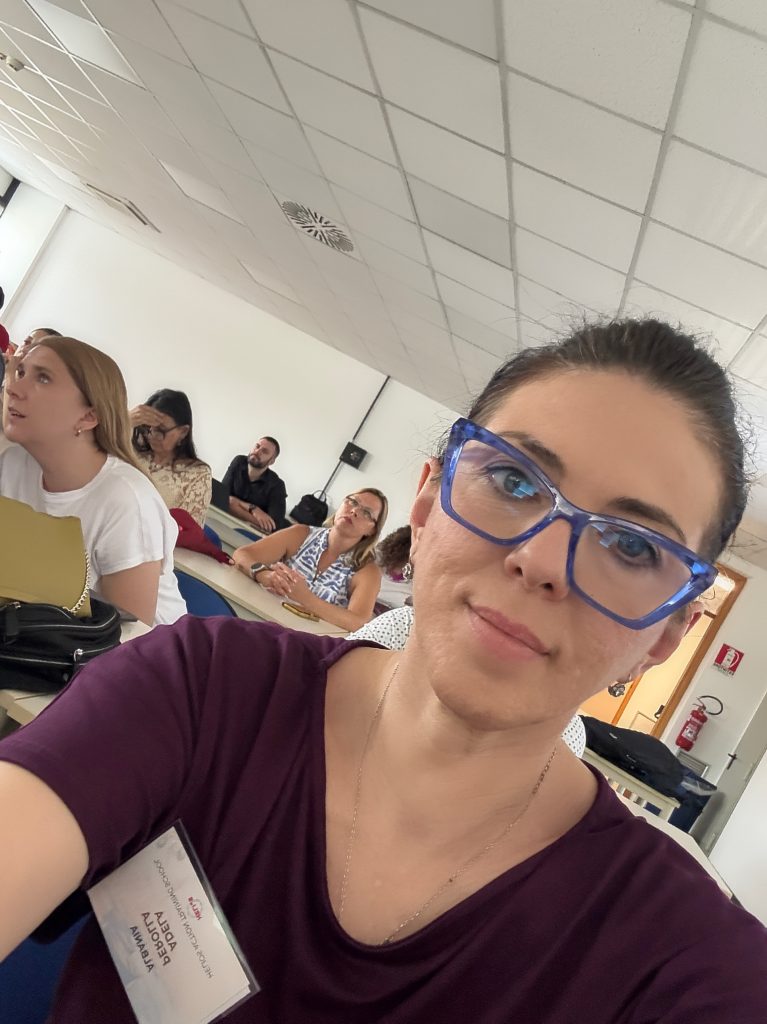
Written by Dr Adela Perolla, Children’s Hospital Zagreb, Croatia
My testimony from HELIOS Action Training School — “Ethics, Gender, Regulation and Use of Data”, Bari, 1–3 July 2026
I left for Bari thinking I was going to a course. I came back with a list of questions I had never asked myself, and that from now on I will ask at the start of every project rather than at the end. Let me try to describe the three days for what they actually left me with.
I had always thought of informed consent as a box to tick. You sign it, you file it, you get started. Then we found ourselves working on it together, in groups, and I understood something no textbook had told me: a consent document can be legally flawless and humanly unreadable. And if it is unreadable, what I have collected is not consent — it is a signature.
With children the point becomes even sharper. In haemoglobinopathies the patient is often a minor, and alongside the parents’ consent there is the child’s assent — their own yes, which counts as a person’s answer and not as a formality. Trying to rewrite a text so that a twelve-year-old genuinely understands it was far harder than I expected. That was the moment I stopped thinking of that piece of paper as an administrative step.
The second day changed a conviction of mine. I work on blood disorders and I have a particular interest in the rare ones. Our cohorts are small, the centres are scattered across Europe, and on our own we never have enough numbers. That is why I had convinced myself that data protection was, in the end, an obstacle to be worked around patiently. The sessions on the GDPR, on the secondary use of data for research purposes and on the European Health Data Space forced me to turn that view upside down. “Share more” is not an ethical position: it is a slogan. The real question is how — with what safeguards, on what legal basis, and with how much control left to the person the data came from. I did not come home an expert. But I understood that knowing the rules does not constrain me: it lets me design more ambitious studies, because I know in advance what is possible instead of finding out too late.
The afternoon on gender and inclusiveness was the one that caught me most off guard. I was expecting a discussion about representation. What I found was a methodological problem: a variable overlooked when a study is designed does not produce a small error — it produces, ten years later, a body of evidence that does not speak to a portion of patients. A study that ignores half the population is not less considerate. It is less true. I wrote that sentence down and have reread it several times since.
The third day. The morning on genetic research showed me how different genomic data are from any other kind: they concern not only the person who provides them, but their siblings, their children, people who have signed nothing. They do not expire, and they are never fully anonymised. The afternoon on artificial intelligence was, for me, the most useful of the three days. Seeing the ethical principles, the new European AI Act and then the real workflow of a clinical model one after another — how it is trained, how it is validated, where it breaks — showed me precisely where regulation meets code, and where instead it leaves uncovered exactly what matters.
But the best part was the people sitting next to me. If I had to point to one reason why this school worked, it would not be the programme. It would be who was in the room. From the
introductions on the first morning it was clear that we were a deeply heterogeneous group: clinicians, geneticists, computer scientists, basic researchers, people who work with health data every day, coming from countries where health systems and research practices work in quite different ways.
At first that heterogeneity feels like a slowdown. Then it becomes the real content of the course. The practical activities and the group restitutions put us in front of the same problem, and each of us approached it with the tools of our own trade: some starting from the regulation, some from the patient in the clinic, some from the database. The most valuable moment was always the same one — someone would say “we can’t do that where I work”, or “we do it differently”, and the conversation would open up.
I learned more in those exchanges than in many hours of solitary reading. And I understood why a network like HELIOS makes sense: not to make practices uniform, but to make differences visible before they turn into inequalities between patients.
I came home with a feeling that was new to me — that of belonging to a European community that is still taking shape around these questions, and that I can therefore help to build. That the right moment to think about data ethics is when I am writing the protocol, not when I am filling in the ethics committee form. That knowing the regulatory framework is not a constraint but a structure, one that allows you to be more ambitious.
And that having someone beside you who asks the uncomfortable question is worth more than any manual.
My sincere thanks to Fondazione per la Ricerca Farmacologica Gianni Benzi – ETS, which conceived and organised this Training School and took care of every aspect of it with an attention that was visible in every session: the choice of topics, the design of the practical activities, and the ability to bring disciplines into conversation that rarely speak to one another.
Thank you to Università degli Studi di Bari for its hospitality, to the HELIOS COST Action for making this meeting possible, and to all the speakers who shared such varied expertise with generosity and clarity.
If you are starting out in research in this field, apply for the next edition. You will not come back with answers — you will discover something far more useful, to put into practice day after day, step after step.
Adela Perolla