
Written by Milana Trucl, Sciensano, Belgium
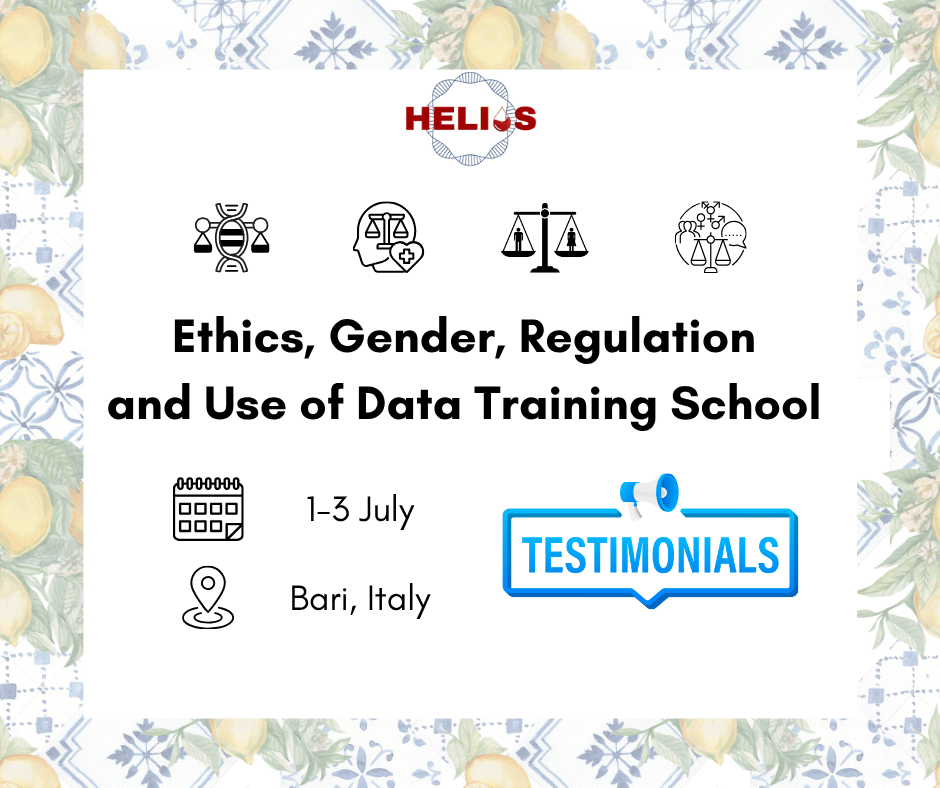
In July 2026, I spent three days in Bari at the HELIOS Training School on “Ethics, Gender, Regulation and Use of Data.” I arrived with a presentation on the European Health Data Space (EHDS) and left with a much richer understanding of one of the many realities that will be impacted by this regulatory framework: that of haemoglobinopathy. The discussions gave me a much more concrete understanding of the haemoglobinopathy research landscape, particularly the challenges created by small, dispersed cohorts and the particular characteristics of genomic data.
My background is in policy and patient advocacy, and I currently work at Sciensano, the Belgian Institute of Public Health. Much of my work involves thinking about frameworks, texts, how rules are written and applied across different contexts, and how citizens and patients can be involved in these processes. What made these three days different was the opportunity to look at these questions through the lens of one specific disease area, and from many different angles at once. This was possible due to a mix of participants from different backgrounds, including researchers, clinicians, geneticists, computer scientists, and ethicists, working directly with haemoglobinopathy. Their questions were sharp, specific, and grounded in experience. We discussed what secondary use legislation means for a rare-disease registry containing only a handful of patients in each country, how an EU-wide framework translates to a small and geographically scattered patient population, how patients can really understand and exercise their rights, and what clinicians and researchers can expect from EHDS-enabled research. These discussions did not challenge the principles behind the regulation. Rather, they recognised the potential benefits and implementation challenges, and brought out the complexity of applying a European framework to very specific research realities.
The other sessions during the training school were particularly interesting and brought out different dimensions of the same underlying question. Discussions on the GDPR and the secondary use of health data, on gender and inclusiveness in research, and on artificial intelligence in genetic research each added their own angle to the conversation. What I found particularly useful was the way these topics were connected back to practice: not just what the rules or principles say, but what they mean for people actually carrying out research and working with patients and their data.
What made the training school particularly effective was also its format, which was genuinely collaborative. We worked in small groups, compared experiences, and questioned each other on details we might otherwise have glossed over. The differences between countries, disciplines, and research settings were not treated as obstacles, but as an enriching learning opportunity. I suspect many of us went home with concrete ideas we are already trying to apply. And beyond the content itself, the school was valuable for the relationships it created, which already translated into collaboration that extends well beyond the training school itself.
For me, that is what made the experience particularly worthwhile. I came to Bari to present on the EHDS, but the most valuable part was the opportunity to see a familiar set of policy and ELSI questions through a much more specific lens, and to do so alongside people whose expertise comes from very different parts of the same research landscape.
My thanks to Fondazione per la Ricerca Farmacologica Gianni Benzi for organising the school with such care, and to the HELIOS COST Action for making the meeting possible, and, above all, to everyone in the room for the questions, perspectives and conversations that made the three days so valuable.